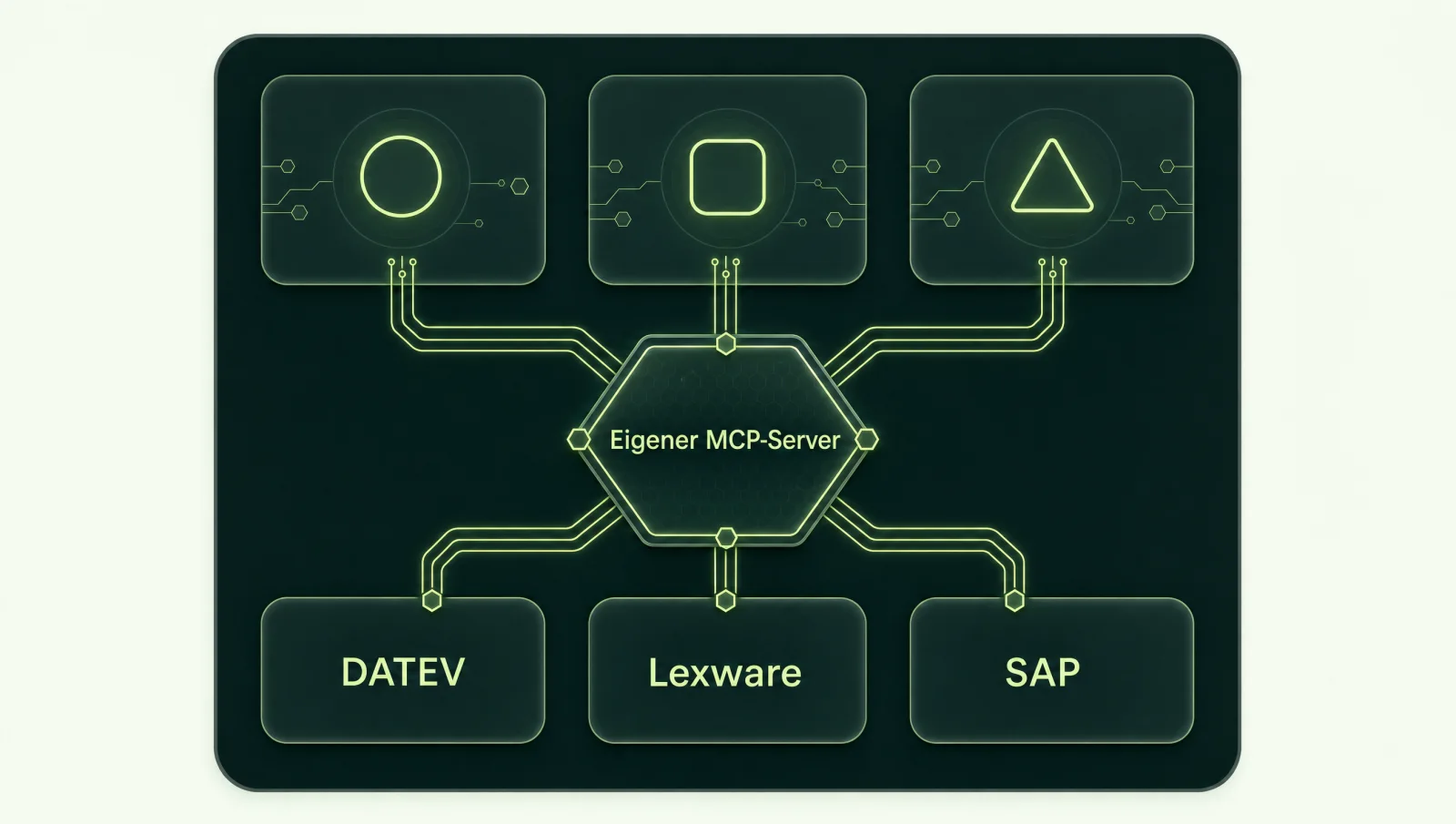
Disclosure: Workflow Agentur is not a partner of Anthropic, OpenAI or Microsoft. We connect company systems to AI assistants through our own MCP servers, and all three assistants can use such servers. Our approach therefore appears as a separate column in the table. It is not an assistant but an additional connection layer, and the column only describes what it changes. This page contains no ranking, no scoring and no prices.
Which criteria can you use to compare Claude, ChatGPT and Copilot?
Compare plans, training, data location, EU commitments, retention, data processing, connectivity, admin controls and security warnings: we set these nine criteria before the research, and each can be checked in the vendors' documentation. They follow from the questions that management, IT and data protection need to clarify before adoption.
- Business plans Which plans exist for organisations.
- Training on company data Whether inputs are used for training by default.
- Data location and data residency Where data is stored and processed.
- EU Data Boundary and exceptions Which EU commitment exists and where it ends.
- Retention How long data is kept and who sets this.
- Data processing (DPA) Whether and how an agreement under Art. 28 GDPR is concluded.
- Connecting your own systems MCP servers and connectors.
- Admin controls Roles, approvals and policies.
- Security warnings What the vendor itself names as a risk.
Every vendor statement comes from that vendor's own documentation, retrieved on 19 November 2026, and applies according to the vendor, as of November 2026. The order is alphabetical by product name. "No information found" means that the sources we read say nothing about it, not that something is missing. On data protection questions we offer general guidance, not legal advice.
Claude, ChatGPT and Copilot compared: all criteria in one table
All vendor information according to the vendor, as of November 2026; the evidence is in the sections below. On small screens you can scroll the table sideways.
| Criterion | ChatGPT (OpenAI) | Claude (Anthropic) | Copilot (Microsoft) | Own MCP server (our approach) |
|---|---|---|---|---|
| Business plans | Business (formerly Team), Enterprise, Edu | Team (2 to 150 seats), Enterprise | Copilot Chat, Microsoft 365 Copilot (Basic without, Premium with add-on licence), Copilot Studio | Not an assistant of its own, uses your plan |
| Training on company data | No, by default | No by default, exception: active feedback | No training of the foundation models | Does not train any model |
| Data location | Europe selectable for new Enterprise/Edu workspaces and API projects. Business: region only for new workspaces, copy kept in the USA for abuse monitoring | USA, no EU storage region directly from Anthropic | EU Data Boundary for EU customers, Copilot Studio with the "Germany" geography | Your infrastructure or a data centre of your choice |
| EU Data Boundary | No information found. Data residency does not cover data flows via external integrations such as apps, MCP and web search | No information found. Inference worldwide by default | Exceptions: Bing web search, Anthropic models (off by default for EU tenants), Flex Routing, Multi-Geo (Microsoft 365) | Documents per tool which data goes to the assistant |
| Retention | Enterprise/Edu: set by admins. Business: conflicting statements on the same page | Custom retention periods only in Enterprise, at least 30 days | Your retention policies apply | How we build it: audit log of every call, retention period as you specify |
| DPA | Business, Enterprise, API, concluded via the DPA form. Contracting party for EEA/CH: OpenAI Ireland | Automatically part of the Commercial Terms | DPA and Product Terms. Independent controller for Bing | With us, if we operate the server |
| Connecting your own systems | Custom MCP servers in Business, Enterprise, Edu | Remote MCP in all plans (Free: one), local in Claude Desktop | MCP via Copilot Studio, federated Copilot connectors | Can in principle be connected to all three, if transport and authentication fit |
| Admin controls | Business: admins publish. Enterprise/Edu: roles, actions can be blocked per app where supported | Team: owners add. Enterprise: custom roles, SCIM, audit logs | Microsoft 365 admin center, data policies also cover MCP | How we build it: fixed tools, permissions per person, approval for write actions |
| Vendor warnings | Prompt injection via insecure MCP servers | Prompt injection, hidden instructions | Customer is responsible for MCP tools, fix oversharing | We limit tools and data access through server-side permission checks |
Which business plans do ChatGPT, Claude and Copilot offer?
For organisations, the options are ChatGPT Business, Enterprise and Edu, Claude Team and Enterprise, and from Microsoft, Copilot Chat, Microsoft 365 Copilot and Copilot Studio. These plans come with central administration and the data protection commitments for businesses; in addition, there are industry-specific offerings such as ChatGPT for healthcare.
ChatGPT: Since 29 August 2025, Team has been called "Business", with a minimum of two seats and, for workspaces created from 24 August 2026, a maximum of 200. Business has single sign-on via SAML and OIDC. SCIM is a feature for Enterprise and Edu; a Business workspace can only use it if the same tenant also has an Enterprise workspace, according to OpenAI, as of November 2026 (Business FAQ, SCIM).
Claude: Team covers 2 to 150 seats, Enterprise starts at 20 seats (self-service) or 50 seats (sales). Single sign-on is available from Team upwards; SCIM and claiming all accounts on the company domain only in Enterprise, according to Anthropic, as of November 2026 (Team, Enterprise, Domain).
Copilot: The "Microsoft 365 Copilot" app is now called "Microsoft Copilot", and the "Microsoft 365 Copilot Chat" app is now "Microsoft Copilot Chat", according to Microsoft, as of November 2026 (Copilot overview). Three things need to be distinguished:
- Copilot Chat is included in eligible Microsoft 365 licences and works with web data, content you provide or open, and agents.
- Microsoft 365 Copilot comes in two tiers: "Basic" refers to users without an add-on licence who have Copilot features in apps such as Word or Excel. "Premium" is the add-on licence with access to emails, files and calendar entries via Microsoft Graph, but only to what the person is allowed to see anyway.
- Copilot Studio is the environment for building your own agents, billed via Copilot Credits (Licensing).
In more detail: ChatGPT for business and Claude for business.
Do ChatGPT, Claude and Copilot train on company data?
No, not by default: all three commit, for their business plans, not to use inputs and outputs for training, each with its own limitations.
ChatGPT: No training on business data from Business, Enterprise, Edu and the API, including data from apps. Exception: you explicitly opt in, for example through the voluntary feedback mechanisms, according to OpenAI, as of November 2026 (Enterprise Privacy).
Claude: No training on content from Team, Enterprise and the API. Feedback exception: a thumbs up or down shares the entire conversation, which can then be stored for up to five years. Owners can switch off the "Rate chats" feature, according to Anthropic, as of November 2026 (Training).
Copilot: Prompts, responses and Graph data are not used to train the foundation models, according to Microsoft, as of November 2026 (Privacy).
Where do ChatGPT, Claude and Copilot store data?
OpenAI offers storage in Europe for certain plans, Anthropic stores in the USA, and Microsoft places Copilot within the EU Data Boundary.
ChatGPT: New Enterprise and Edu workspaces and eligible API projects can choose storage in Europe (EEA and Switzerland). In ChatGPT, computation on the GPU within the region (inference residency) is only available for Enterprise and Edu; other processing may still run worldwide. Not covered is data processed outside OpenAI's infrastructure via external integrations such as apps, MCP or web search (Data residency). In the API, inference also runs in the region if the region, endpoint and model support it (API residency). In Business, you choose the region, where available, when setting up a new workspace; it cannot be enabled or changed afterwards. If a region outside the USA is selected, OpenAI temporarily stores a copy of every prompt and every response in the USA for abuse monitoring, according to OpenAI, as of November 2026 (Business data location).
Claude: According to Anthropic, it stores data in the USA; Anthropic does not offer an EU storage region directly. By default, processing can be routed to selected countries in the USA, Europe, Asia and Australia, unless otherwise agreed or instructed (Server locations, API). Claude is also available via AWS Bedrock, Google Vertex AI and Microsoft Foundry, where their own terms apply.
Copilot: For EU customers, Copilot is an EU Data Boundary service. Copilot Studio has the "Germany" geography with Germany North (Berlin) and Germany West Central (Frankfurt). Connected external services can transfer data out of the region, according to Microsoft, as of November 2026 (Locations).
What does the EU Data Boundary cover, and what are the exceptions?
Only Microsoft documents an EU Data Boundary, and Microsoft itself names exceptions: web search, Anthropic models, Flex Routing and Multi-Geo customers.
Microsoft commits to storing and processing customer data in the EU and EFTA, with limited, documented transfers. For this, Copilot Studio environments need an EU region and a billing address in an EU Data Boundary country (EU or EFTA), according to Microsoft, as of November 2026 (EU Data Boundary). Exceptions:
- Web search: Bing queries are not covered; Microsoft acts as an independent controller there (Enterprise Data Protection).
- Anthropic models: Claude models in Copilot are currently excluded (Privacy). For customers in the EU Data Boundary and in the United Kingdom, they are disabled by default (Claude models in Copilot).
- Flex Routing: At peak load, the language model may run outside the boundary. For eligible tenants created after 25 March 2026, this is on by default. Older tenants should check the setting; customers in the EU and EFTA can switch it off in the Microsoft 365 admin center (Flex Routing).
- Multi-Geo and network: For Microsoft 365, Multi-Geo customers are not covered (EU Data Boundary). During network transit, data may cross the boundary (Product Terms).
For ChatGPT, data residency with the limits described is the closest equivalent; for Claude, we found no EU commitment. For none of the three can a commitment that data never leaves Europe be derived from the documentation.
How long do the vendors retain chats and data?
OpenAI and Anthropic usually remove deleted chats within 30 days; who can set the retention period depends on the plan, and Microsoft applies your own policies.
ChatGPT: In Enterprise and Edu, admins set the retention period. For Business, OpenAI gives conflicting information on the same page: the header lists configurable retention only for Enterprise, Healthcare and Edu, while the Business FAQ states that workspace admins can set how long data is retained. Have the exact scope confirmed before signing the contract. Deleted chats are usually removed within 30 days, with exceptions for legal and security reasons (Enterprise Privacy). In the API, abuse logs are kept for up to 30 days; Zero Data Retention is only available after approval by OpenAI (API data).
Claude: Custom retention periods are only available in Enterprise, with a minimum of 30 days, not for all products, and for chats in projects the project retention period takes precedence (Retention). Anthropic usually removes deleted chats within 30 days, unless required by law or to address violations. Content flagged as a violation can be kept for up to two years (Retention period). Certain newest models have their own retention rules; check them before use (Covered Models).
Copilot: Copilot inherits permissions and sensitivity labels and applies your retention policies. Which controls apply depends on the subscription, according to Microsoft, as of November 2026 (Enterprise Data Protection).
Is there a data processing agreement (DPA)?
Yes, all three provide a DPA for business plans and act as processors, each with its own exceptions.
ChatGPT: You conclude the DPA for Business, Enterprise and the API via the DPA form (Enterprise Privacy). For the EEA and Switzerland, OpenAI Ireland is the contracting party; transfers to third countries rely on Standard Contractual Clauses or an adequacy decision, and objections to new sub-processors can be raised within 30 days (DPA). This does not mean processing takes place exclusively in the EU.
Claude: The DPA is automatically part of the Commercial Terms, with Standard Contractual Clauses Modules 2 and 3 and a 15-day objection period for new sub-processors, according to Anthropic, as of November 2026 (DPA).
Copilot: DPA and Product Terms, with Microsoft as processor for the core service. For Bing web search, Microsoft is an independent controller; Anthropic models in Copilot run as sub-processors of Microsoft, currently outside the EU Data Boundary, and are switched off by default for customers in the EU. For certain newest Claude models "with Data Retention", Anthropic is an independent processor under Anthropic's terms, not under Microsoft's Product Terms and DPA (Enterprise Data Protection, Claude models in Copilot).
The legal basis, the record of processing activities and informing data subjects remain your responsibility, see MCP server, security and GDPR.
How do ChatGPT, Claude and Copilot connect to your own systems?
All three support the open Model Context Protocol (MCP), but differ in plans, enablement and how the server must be reachable.
ChatGPT: In Business, Enterprise and Edu, custom MCP servers can be added directly on the web under "Plugins"; Developer Mode no longer needs to be switched on for this. The connection is made to a public HTTPS endpoint or a Secure MCP Tunnel. In Business, only admins and owners create and publish them, according to OpenAI, as of November 2026 (MCP in ChatGPT).
Claude: Remote MCP connectors are available in all plans, one in the Free plan. The connection originates in Anthropic's cloud, so the server normally has to be publicly reachable. For Enterprise, Anthropic offers MCP Tunnels on request as a research preview: a tunnel in the company network establishes an outbound connection to Anthropic, the server does not need a public endpoint and should itself require OAuth authentication. With a shared API key, everyone shares the same identity (Remote MCP, MCP Tunnels). Local servers run in Claude Desktop. More under Claude and MCP.
Copilot: Copilot Studio has supported MCP in general availability since 29 May 2025 (Announcement), via Streamable HTTP, with an API key or OAuth 2.0 and generative orchestration switched on (Adding an MCP server). The former Graph connectors are now called Copilot connectors; the federated variant retrieves data live via MCP (Federated connectors). Copilot Studio reaches systems in the company network via custom connectors with the on-premises data gateway, which only needs outbound connections (Gateway). More under Copilot Studio MCP server.
In principle, an MCP server can be reused for several assistants if the transport (Streamable HTTP), authentication and the protocol features used are supported by the product in question.
What can admins control in ChatGPT, Claude and Copilot?
In all three, admins control which connections, agents and actions your team may use; roles, approvals and audit logs expand with the plan.
ChatGPT: In Business, apps are active by default and can be switched off for the whole workspace. In Enterprise and Edu, admins assign the right to create MCP servers via roles and switch individual actions on or off, where the app in question supports this (Admin controls). In Enterprise, workspace agents are off by default at launch (Workspace Agents).
Claude: In Team, only owners and primary owners add connectors (Remote MCP). Enterprise adds custom roles, audit logs and a Compliance API (Enterprise, Roles). Desktop extensions can be restricted via an allowlist (Allowlist); for central sign-in to connectors, the route via the identity provider is generally available, while sign-in issued by Claude is still in beta (Auto-Connect).
Copilot: In the Microsoft 365 admin center, admins enable, block and assign agents. Organisation-wide publishing goes through an approval, but creators can also share agents themselves (Managing agents). Data policies in the Power Platform admin center also apply to MCP servers (Data policies).
What do the vendors themselves warn about?
All three name prompt injection and third-party MCP servers as a risk and place responsibility for reviewing connected tools with the customer.
- OpenAI: Insecure MCP servers increase the risk of prompt injection; particularly risky actions can be blocked (Source).
- Anthropic: Malicious MCP servers can contain hidden instructions (Source). Anthropic itself calls Claude in Chrome "still risky" (Source). In high-risk areas such as personnel selection or credit, the Usage Policy requires human review and disclosure, with narrowly defined exceptions (Usage Policy).
- Microsoft: Customers are responsible for the tools integrated via MCP (Source). Before Microsoft 365 Copilot, overly broad sharing permissions should be fixed; SharePoint Advanced Management is included in the Copilot licence for this, while Purview has its own licensing requirements (Source).
How such attacks work is explained under Prompt injection and AI security.
Which one suits which company?
What matters are your existing systems, your binding data requirements and the tasks the assistant is meant to take on. The cases are decision aids, not a ranking.
You work in Microsoft 365 and want to use permissions from SharePoint
Then Copilot is the obvious choice: Microsoft 365 Copilot only sees via Microsoft Graph what the person is allowed to see. This requires clean permissions; otherwise overly broad sharing becomes visible.
EU storage is mandatory
What is documented is Microsoft's EU Data Boundary with its exceptions and storage in Europe for new ChatGPT Enterprise and Edu workspaces and API projects. According to Anthropic, it stores data in the USA. In each case, check what runs via apps, MCP and web search.
A small team wants to start without being tied to Microsoft
ChatGPT Business and Claude Team start at two seats, have single sign-on and allow custom MCP servers. The differences lie in data location, retention and enablement.
Several assistants are already in use
Then separate the connection from the choice of assistant. An own MCP server can provide the same tools to several assistants if transport and authentication fit. This is how we build it: with permissions per person and an audit log of every call. The integration logic can be reused; we check the connection and approvals for each assistant.
Strict requirements can also be met with a locally operated model, see Local AI in the enterprise.
How do ChatGPT, Claude and Copilot connect to DATEV, Lexware or SAP?
Through an MCP server that translates the system's interface into fixed tools. Because all three support MCP, the same server can in principle be connected to each of them, if transport, authentication and the protocol features used fit the product.
DATEV: According to our overview as of November 2026, there is no MCP server from DATEV itself, but there are third-party offerings and the option of a custom build, see DATEV MCP servers compared and MCP server for DATEV. On "Copilot DATEV": Microsoft's list of federated Copilot connectors includes a DATEV connector from a third-party provider (Federated connectors). The listing does not describe its exact range of functions.
Lexware: An MCP server connects to the Lexware Office interface. Which version is required and what stays in Lexware itself is covered under MCP server for Lexware Office.
SAP: For "Copilot SAP", as for any assistant, the SAP API Policy has applied since April 2026. Section 2.2.2 prohibits the use of SAP interfaces by AI systems that plan, select or execute sequences of API calls outside the paths recognised by SAP (SAP API Policy). According to the SAP FAQ, custom MCP servers are permitted if the entire use complies with the contract, documentation and policy, with full responsibility for operation and maintenance resting with the customer (SAP FAQ, question 56). Details under MCP server for SAP.
Microsoft 365: Claude has a Microsoft 365 connector. In Team and Enterprise, an owner enables it for the organisation; for work accounts, one-time consent from an Entra Global Admin is required, and it can also write and send (Connector). Further options under MCP server for Microsoft 365.
How we build it: read-only tools first, write tools only with a human approval step. Basics under What is an MCP server?, all systems in the MCP cluster.
All sources on this page were retrieved on 19 November 2026. If any information is no longer current, write to info@weber-media.com and we will correct it.
Frequently asked questions about Claude vs ChatGPT vs Copilot
Is ChatGPT or Copilot better for businesses?
That depends on your starting point. Copilot accesses company data in Microsoft 365 via Microsoft Graph and, for EU customers, is an EU Data Boundary service, with named exceptions. ChatGPT offers storage in Europe for new Enterprise and Edu workspaces. Both support custom MCP servers.
Does Claude store data in the EU?
No. According to Anthropic, it stores data in the USA; Anthropic does not offer an EU storage region directly. Via cloud platforms such as AWS Bedrock, Google Vertex AI or Microsoft Foundry, their own terms apply.
Does the EU Data Boundary cover everything in Copilot?
No. Microsoft names exceptions: Bing web search, Anthropic models, Flex Routing at peak load and Multi-Geo customers. Flex Routing is on by default for eligible tenants created after 25 March 2026 and can be switched off in the Microsoft 365 admin center.
What is the difference between Copilot Chat, Microsoft 365 Copilot and Copilot Studio?
Copilot Chat is included in eligible Microsoft 365 licences and works with web data and content you provide. Microsoft 365 Copilot comes as Basic without an add-on licence and as Premium with an add-on licence and access to company data via Microsoft Graph. In Copilot Studio, you build your own agents and connect systems.
Can all three access DATEV, Lexware or SAP?
Yes, in principle via an MCP server, because all three support the Model Context Protocol. Transport and authentication must fit the product in question. For SAP, the SAP API Policy also applies, which restricts AI access outside recognised paths. You decide which data the server exposes and who may write.
Do we need our own MCP server?
Not always. Ready-made connectors exist for Microsoft 365 and many cloud services. An own server is worthwhile if a system has no suitable connector, if you need permissions per person and an audit log of every call, or if several assistants are to use the same tools.
AI Check: which assistant fits your systems?
In the AI Check, we clarify your starting point, data protection requirements and systems in 30 minutes, and you then receive a one-page recommendation. Or write briefly which assistant you use and what should be connected: you will receive a written assessment, without an appointment and without a sales pitch.
Thank you, your enquiry has arrived.
We usually reply by email within one working day.
Prefer to talk directly? Book a 30-minute AI Check